Your Zapier bill will double every time your business grows
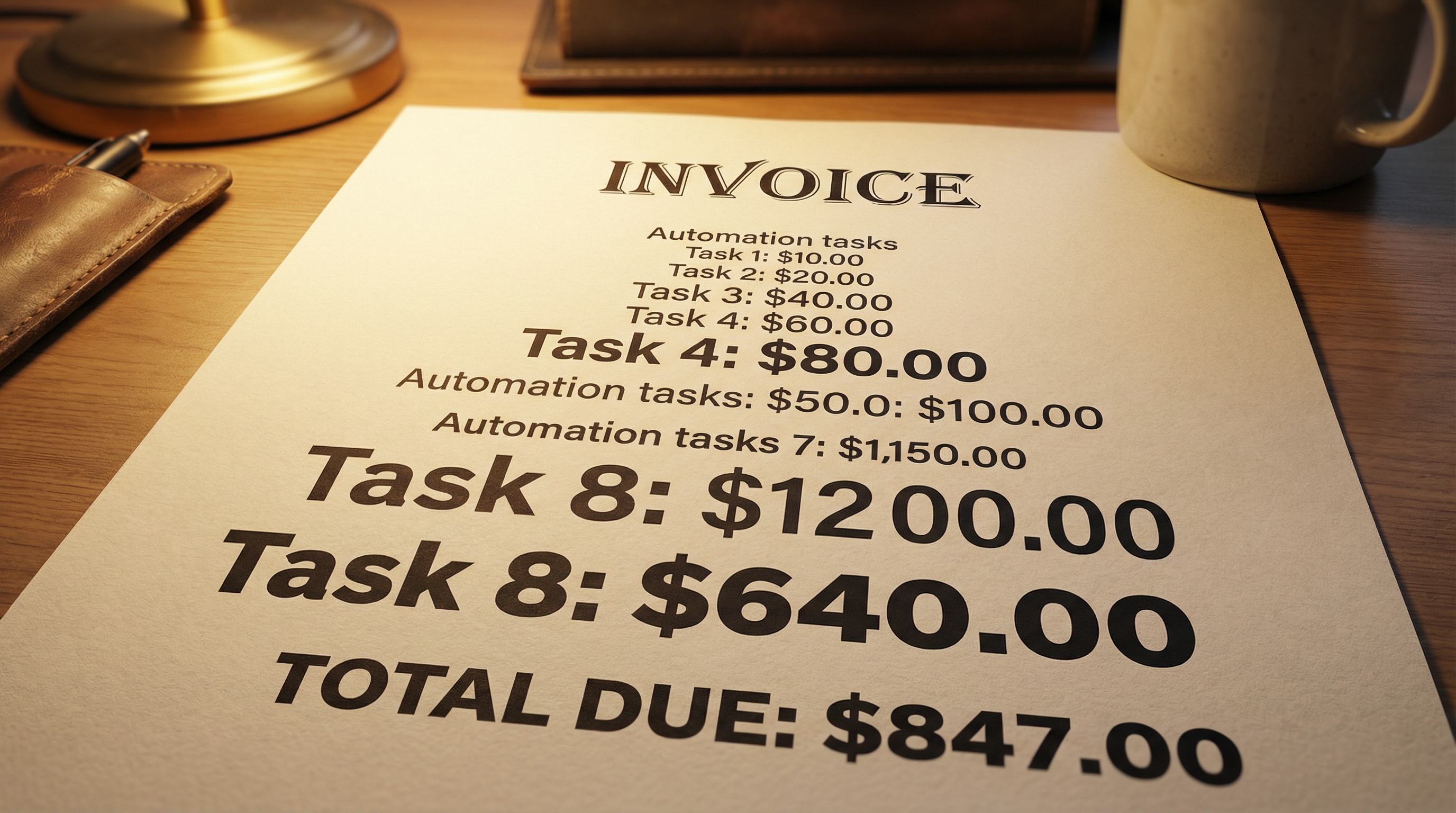
Per-task pricing punishes growing businesses. The more automations you build, the more steps each workflow has, the faster the bill climbs. We've tracked this pattern across community forums, Reddit threads, and customer invoices for the past year, and the trajectory is always the same.
A Reddit thread in February 2026 laid out the math. A business running simple automations was paying $847 per month on Zapier. CRM updates, email alerts, Slack notifications. Nothing exotic and nothing enterprise-grade, but fifteen thousand tasks per month at the per-task rate.
The thread catalyzed a broader conversation across r/aiagents and r/automation, with posts titled "TIRED OF ZAPIER" and "Best Zapier alternatives that won't destroy your budget." Every small business owner reading it recognized the trajectory because their own Zapier bill had been climbing for months.
The explanation is structural. Zapier's pricing model counts every action step as a separate task. An 8-step workflow that routes a lead from a form to the CRM, sends an email, posts to Slack, and creates a follow-up task consumes 8 tasks per execution. Not 1 task for the run. Eight tasks, one for every step.
Run that workflow 200 times per month and the business burns through 1,600 tasks. Run it 1,000 times and the total hits 8,000 tasks. The bill doesn't grow linearly with the business. It grows with the number of steps times the number of executions, and both numbers increase as the business improves its automations.
The business grows. The bill accelerates faster.
How Zapier counts tasks
Every action step in a Zap counts as one task. Triggers don't count. Filters, Formatters, and Paths don't count. But every step that does something, sends an email, creates a record, posts a message, that's a task.
This matters because most real-world automations aren't single-step. A lead capture workflow looks like this:
- Trigger: New form submission (free, doesn't count)
- Format: Clean up the data (free, doesn't count)
- Create: Add contact to CRM (1 task)
- Send: Welcome email (1 task)
- Post: Slack notification to sales (1 task)
- Create: Follow-up task in project tool (1 task)
- Add: Contact to email marketing list (1 task)
- Update: Reporting spreadsheet (1 task)
Six tasks per lead. Not one.

At 200 leads per month, this workflow uses 1,200 tasks. At 1,000 leads, 6,000 tasks. At 5,000 leads, 30,000 tasks.
The base Professional plan includes 750 tasks for $29.99 per month. Most real businesses blow past that limit in the first week.
The cost at real volumes
We compared the same 8-step lead workflow across four platforms at three volume levels. The results are not close.
At 1,000 leads per month (8,000 action steps)
Platform | Pricing model | Monthly cost |
|---|---|---|
Zapier | Per task (8,000 tasks) | ~$89-149 |
Make | Per credit (8,000 credits) | $10.59-18 |
n8n Cloud | Per execution (1,000 executions) | ~$24 (EUR) |
n8n Self-hosted | Unlimited | $5-10 hosting |
Activepieces | Flat plan | $0 (self-hosted) |
At 5,000 leads per month (40,000 action steps)
Platform | Pricing model | Monthly cost |
|---|---|---|
Zapier | Per task (40,000 tasks) | ~$299-599 |
Make | Per credit (40,000 credits) | ~$45 |
n8n Cloud | Per execution (5,000 executions) | ~$60 (EUR) |
n8n Self-hosted | Unlimited | $10-50 hosting |
Activepieces | Flat plan | $0 (self-hosted) |
At 15,000 leads per month (120,000 action steps)
Platform | Pricing model | Monthly cost |
|---|---|---|
Zapier | Per task (120,000 tasks) | ~$847+ |
Make | Per credit (120,000 credits) | ~$135 |
n8n Cloud | Per execution (15,000 executions) | ~$120 (EUR) |
n8n Self-hosted | Unlimited | $20-75 hosting |
Activepieces | Flat plan | $0-25 (self-hosted) |
The Reddit user paying $847 per month could run the exact same workflows on Make for about $135. On n8n Cloud for about $120. On self-hosted n8n for under $75.
That is not a marginal difference. That is 6x to 10x cheaper for the same work.
Why the counting model is the real problem
The per-task model creates a specific pathology. It punishes you for building better automations.
A simple 2-step Zap that catches a form submission and emails you costs 1 task per execution. A proper 8-step workflow that routes the lead, enriches the data, notifies your team, and creates follow-up tasks costs 8 tasks per execution. The better automation costs 8 times more.
You built a more valuable workflow. Zapier charges you more for it. Not because it uses more server resources. Because the pricing model counts actions, not value.
Make charges per operation, which works similarly. But at $10.59 per month for 10,000 operations, the base allotment is so much larger that most small businesses never exceed it.
n8n charges per execution. The entire workflow run counts as one execution regardless of how many steps it contains. An 8-step workflow and a 2-step workflow cost the same. This is why n8n is dramatically cheaper at scale.
Activepieces offers a completely free self-hosted edition with no per-execution charges.
The overage trap
Zapier offers an opt-in "pay-per-task" billing mode. If you enable it, your Zaps keep running when you exceed your plan's task limit, and Zapier charges overages at 1.25x the base cost per task, up to 3x your plan limit.
If you don't enable it, your Zaps simply pause when you hit the ceiling. Both outcomes are bad. Either your automations stop working mid-month, or your bill climbs without a clear ceiling.
The overage math gets expensive fast. At 1.25x the base rate, 5,000 extra tasks on the Professional plan costs roughly $125 in overages on top of your subscription.

We've tracked the pattern across community forums and Reddit. Businesses that start on Zapier's free or Starter tiers frequently hit an inflection point between month 3 and month 6 where their bill jumps from under $50 to over $200. The jump comes from two sources: more workflows and more steps per workflow.
The improvements make the bill worse. Better automations with more steps cost more per execution. More automations serving more business processes add more total executions. Both axes grow simultaneously.
When Zapier still makes sense
We don't believe in universal recommendations. Zapier has the largest app directory with over 7,000 integrations and genuinely the lowest setup friction of any automation platform.
If you've never built an automation before, Zapier gets you working in 30 minutes. That has real value.
The right use case for Zapier in 2026 is a business with low volume, simple workflows, and no in-house technical capability. Under 500 executions per month with 2 to 3 step workflows. At that level, the per-task pricing doesn't hurt because the total task count stays manageable.
The wrong use case for Zapier is anything that scales. The moment your lead volume grows, or you build a workflow with more than 4 steps, or you add a second workflow, the per-task model starts working against you.
What we recommend
The first step is calculating actual task consumption, not workflow count but total task count. Multiply the number of steps in each workflow by the number of times it runs per month, then add them up. That number determines the bill.
Under 750 tasks per month. Stay on Zapier. The convenience justifies the cost at that volume.
Between 750 and 5,000 tasks per month. Migrate to Make. The visual builder is comparable, the learning curve is one afternoon, and costs drop 50% to 80% immediately. Make's Core plan runs $10.59 per month for 10,000 operations.
Over 5,000 tasks per month with a technical team. Self-host n8n. Per-execution costs go to zero and the total cost becomes the $10 to $50 per month hosting fee, regardless of workflow complexity.
Over $300 per month with no technical team. Hire an automation consultant. A one-time setup fee of $500 to $2,000 to migrate workflows to a cheaper platform pays for itself in two to four months.
The math is not complicated. The cost of waiting is.
We've watched businesses stay on Zapier for 18 months after the bill crossed $500 per month because migration felt hard. The total cost of that delay was $9,000 or more, and migration takes a weekend. Every month a growing business waits, the gap between what it pays and what it should pay gets wider.
We've seen this pattern in every market we track. The businesses that move to the right platform at the right volume save more than the ones that optimize within the wrong platform. Per-task pricing in a growing business is a structural problem, not a settings problem.
The bill will double before most businesses notice.
Pricing verified March 2026 from official platform pricing pages. Reddit thread data from r/aiagents (Feb 14, 2026) and r/automation (2025-2026).
Crux helps businesses find the right automation platform for their specific problem. We don't sell automation tools. We help you pick the right one.
Related Posts
Make.com quietly changed its pricing again
Make.com raised prices twice in four months and your workflows kept running like nothing happened. That was the point. The changes arrived as help center blog posts, not as emails to accounts payin...

How much does workflow automation actually cost in 2026
The number on your automation invoice is never the real cost. Platform subscriptions account for roughly 30% of what businesses actually spend on workflow automation. The rest hides in implementati...