How much does workflow automation actually cost in 2026

The number on your automation invoice is never the real cost. Platform subscriptions account for roughly 30% of what businesses actually spend on workflow automation. The rest hides in implementation time, maintenance hours, consultant fees, and scaling surprises that hit three to six months after launch.
We've tracked automation spending across hundreds of small businesses over the past year. The pattern is consistent. Businesses budget for the subscription. They don't budget for the five hours a week someone spends fixing broken workflows, the $2,000 consultant engagement when something outgrows the free tier, or the migration cost when they realize they picked the wrong platform.
This is a complete cost breakdown for 2026, not just the sticker prices but everything that actually shows up on the balance sheet.
The platform pricing breakdown
Six platforms dominate the market in 2026. Their pricing models are fundamentally different, and those differences determine your total cost more than the base subscription does.
Zapier
Zapier charges per task, and every action step in a workflow counts as one task. An 8-step workflow processing one lead consumes 8 tasks, not 1.
Plan | Monthly (annual billing) | Monthly (monthly billing) | Tasks included |
|---|---|---|---|
Free | $0 | $0 | 100 |
Professional | $19.99 | $29.99 | 750 |
Team | $69 | ~$103.50 | 2,000 |
Enterprise | Custom | Custom | 100,000+ |
Overages cost 1.25x the base per-task rate. Exceed 750 tasks on Professional and the workflows either pause or the overage premium kicks in, up to 3x the plan limit. The Team plan at 5,000 tasks runs about $300 per month. At 10,000 tasks, roughly $600.
Make
Make charges per operation, where triggers, actions, and searches each consume one operation. A typical workflow run uses 3 to 8 operations depending on complexity.
Plan | Monthly (annual billing) | Operations included |
|---|---|---|
Free | $0 | 1,000 |
Core | $10.59 | 10,000 |
Pro | $18.82 | 10,000 |
Teams | $34.12 | 10,000 |
Enterprise | Custom | Custom |
The difference between Core, Pro, and Teams is features, not operation volume. All paid plans start at 10,000 operations. Unused operations roll over one month on paid plans.
n8n
n8n charges per execution, where one workflow run equals one execution regardless of how many steps it contains. An 8-step workflow and a 2-step workflow cost the same.
Plan | Monthly cost | Executions included |
|---|---|---|
Community (self-hosted) | $0 | Unlimited |
Starter (cloud) | $24 | 2,500 |
Pro (cloud) | $60 | 10,000 |
Business (cloud) | $800 | 40,000 |
Self-hosted n8n is free with unlimited executions. The only cost is the server, and a production setup on a $10 to $50 VPS handles most small business workloads. Proper production infrastructure with monitoring and backups runs $200 to $500 per month.
Activepieces
Activepieces is open source under the MIT license, and self-hosted is free with unlimited executions. Cloud pricing works on a different model.
Plan | Monthly cost | Key limits |
|---|---|---|
Self-hosted | $0 | Unlimited tasks |
Cloud (free) | $0 | 10 active flows |
Plus | $25 | Additional flows at $5/flow |
Business | $150 | Expanded features |
Cloud plans charge $1 per 1,000 task executions on top of the base subscription.
Power Automate
Microsoft Power Automate uses per-user and per-flow licensing. The pricing model is more complex than any competitor.
Plan | Monthly cost | Model |
|---|---|---|
Premium (per user) | $15/user | Individual use |
Process (per flow) | $150/flow | Shared team flows |
Hosted Process | $215/flow | Dedicated infrastructure |
A 10-person team where everyone needs automation access costs $150 per month on per-user licensing. Three shared team flows on the Process plan cost $450 per month. The math adds up fast.
IFTTT
IFTTT targets consumers and simple automations. Not a serious business platform, but worth noting for comparison.
Plan | Monthly cost | Applets |
|---|---|---|
Free | $0 | 2 |
Pro | $2.99 | 20 |
Pro+ | $8.99 | Unlimited |

The costs nobody puts on the pricing page
Platform subscriptions are the visible part. The numbers above are accurate but incomplete. They are also the minority of real cost. Here is where the real money goes.
Implementation time. Setting up your first five workflows takes 20 to 40 hours when learning from scratch. That's a week of someone's time. A team billing at $75 per hour internally absorbs $1,500 to $3,000 in opportunity cost before a single workflow runs.
Consultant fees. Workflow automation specialists charge $60 to $150 per hour. A basic implementation engagement runs $2,500 to $5,000. Enterprise-grade custom automation systems run $30,000 to $250,000. Most small businesses land in the $500 to $3,000 range for initial setup help.
Maintenance hours. This is the cost that compounds. We've tracked it across our network and the number is consistent. Someone on your team spends 3 to 5 hours per week maintaining automations once the count exceeds ten active workflows. API changes break connections. Schema updates cause silent failures. Error notifications pile up.
The maintenance burden equals 15% to 25% of your initial implementation cost annually. Every year. It does not decrease over time because the platforms your workflows connect to keep changing their APIs.
Migration costs. When a business outgrows a platform or realizes the pricing model works against it, migration takes 20 to 80 hours depending on workflow complexity. That delay is expensive. We've seen businesses postpone migration for 18 months because it felt hard, spending $9,000 or more in excess platform costs while waiting.
What it costs at three business sizes
The abstract pricing tables don't tell the full story. Real cost depends on your volume, your complexity, and whether the team has someone technical. Here are three scenarios based on patterns we've tracked.
Solopreneur running 5 workflows
A typical setup: lead capture form, email sequence trigger, CRM update, invoice generator, and Slack notification. About 500 executions per month, 2,000 to 4,000 total action steps.
Cost category | Zapier | Make | n8n Cloud |
|---|---|---|---|
Platform | $29.99/mo | $10.59/mo | $24/mo |
Overage risk | High at 4,000 tasks | Low | None |
Setup time (hours) | 10 | 15 | 20 |
Monthly maintenance | 1 hr | 1 hr | 1-2 hrs |
Year 1 total cost | $600-$1,200 | $250-$400 | $350-$500 |
At this scale, Make is the cheapest cloud option. The extra setup time on n8n pays back within six months if volumes grow.
10-person team running 20 workflows
The team processes leads, manages customer onboarding, syncs data between four SaaS tools, generates reports, and handles internal notifications. About 5,000 executions per month, 25,000 to 40,000 total action steps.
Cost category | Zapier | Make | n8n Cloud | n8n Self-hosted |
|---|---|---|---|---|
Platform | $300-$600/mo | $34.12/mo | $60/mo | $0 |
Server costs | N/A | N/A | N/A | $30-$80/mo |
Consultant setup | $2,000 | $2,500 | $3,000 | $3,500 |
Monthly maintenance | 4 hrs | 3 hrs | 3 hrs | 5 hrs |
Year 1 total cost | $6,600-$10,200 | $2,900-$3,500 | $3,700-$4,200 | $4,200-$5,000 |
The gap widens here. We've analyzed this inflection point across dozens of teams. Zapier's per-task model turns a growing team into a growing bill. Make's 10,000-operation base covers many teams without upgrades. Self-hosted n8n looks expensive in Year 1 because of setup and maintenance, but Year 2 costs drop to $360 to $960 for hosting alone.
50-person company running 50+ workflows
Automation runs across sales, marketing, operations, HR onboarding, and financial reporting. About 30,000 executions per month, 150,000+ total action steps.
Cost category | Zapier | Make | n8n Self-hosted |
|---|---|---|---|
Platform | $2,000-$5,999/mo | $200-$500/mo | $0 |
Infrastructure | N/A | N/A | $200-$500/mo |
Dedicated staff | Part-time ($2,000/mo) | Part-time ($2,000/mo) | Full-time ($5,000/mo) |
Consultant/integrator | $5,000-$15,000 | $5,000-$10,000 | $10,000-$20,000 |
Year 1 total cost | $53,000-$96,000 | $32,000-$42,000 | $75,000-$90,000 |
At this scale, the calculation flips. Make delivers the best total cost. Self-hosted n8n has zero platform fees but requires a dedicated operations person. Zapier becomes the most expensive option by a wide margin. The gap is enormous. The platform fee alone can exceed what a competitor charges for the entire automation function.

The free tier trap
Every platform offers a free tier. Every free tier is designed to create lock-in before the real price appears.
Zapier's free tier gives you 100 tasks per month. That is enough for roughly one 5-step workflow running 20 times. You build your workflows, learn the interface, connect your tools. Then the business grows. The 100-task limit breaks in the first week and the automations stop. The upgrade path is $19.99 per month minimum, and most real workloads blow past 750 tasks within 60 days.
Make's free tier gives you 1,000 operations with a 15-minute minimum interval between runs. You build scenarios, connect apps. The 15-minute restriction makes your automations feel sluggish compared to the paid experience. The upgrade to Core at $10.59 removes the constraint. The free tier trained you on the paid interface. That was the point.
n8n's Community Edition is genuinely free with no execution limits. The trap is different. The business invests time learning a more technical platform. Workflows grow complex. Then it needs features like SSO, source control, or team collaboration. The free version doesn't have them. Those features exist only on paid plans starting at $24 per month for cloud or on the new paid self-hosted Business tier.
The pattern is the same across every platform. Free tiers are customer acquisition tools. They get your workflows embedded deeply enough that switching costs exceed the subscription fee. By the time the real price appears, the business depends on the automations it built.
We've watched this cycle repeat across every platform we track. Businesses start free. They build five to ten workflows over two to three months. Then the bill arrives. The businesses that planned for this transition pay the right amount on the right platform. The ones that didn't plan pay whatever the platform they happened to start on charges.
The number that matters
The total automation cost in 2026 is not the platform subscription. It is the subscription plus implementation time plus maintenance hours plus scaling costs plus the migration most businesses eventually need when they outgrow the pricing model they started on.
For most small businesses, that total falls between $3,000 and $12,000 per year. For growing companies, $30,000 to $90,000. The range is wide. The platform choice at the start determines the trajectory.
We've seen businesses cut their automation spend by 60% to 80% by switching from per-task pricing to per-execution or self-hosted models. We've also seen businesses spend more on the "free" platform because the maintenance burden consumed engineering time that cost more than a paid subscription would have.
The cheapest automation platform is the one that matches your growth curve. Not the one with the lowest sticker price today, and not the one with the most generous free tier. The one where your costs scale linearly while your business scales exponentially.
Pick the pricing model before you pick the platform. Everything else follows from that.
Pricing verified March 2026 from official platform pricing pages: zapier.com, make.com, n8n.io, activepieces.com, microsoft.com, ifttt.com. Consultant rate data from Upwork, ZipRecruiter, and industry surveys. Implementation cost estimates based on Intuz and Digital Agency Network 2026 reports.
Crux helps businesses find the right automation platform for their specific problem. We don't sell automation tools. We help you pick the right one.
Related Posts
Make.com quietly changed its pricing again
Make.com raised prices twice in four months and your workflows kept running like nothing happened. That was the point. The changes arrived as help center blog posts, not as emails to accounts payin...
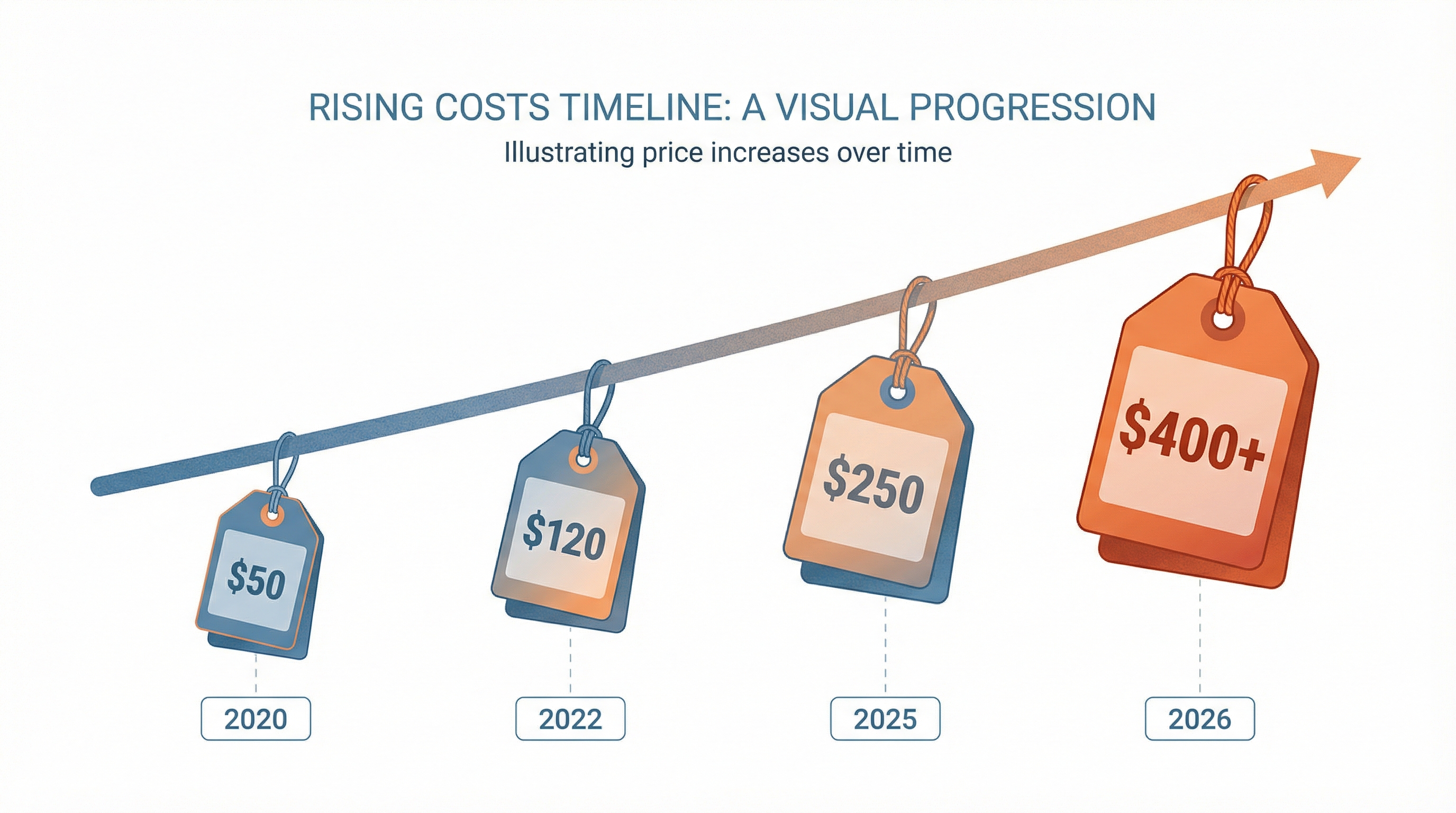
Your Zapier bill will double every time your business grows
Per-task pricing punishes growing businesses. The more automations you build, the more steps each workflow has, the faster the bill climbs. We've tracked this pattern across community forums, Reddi...