Your software stack is about to get smaller
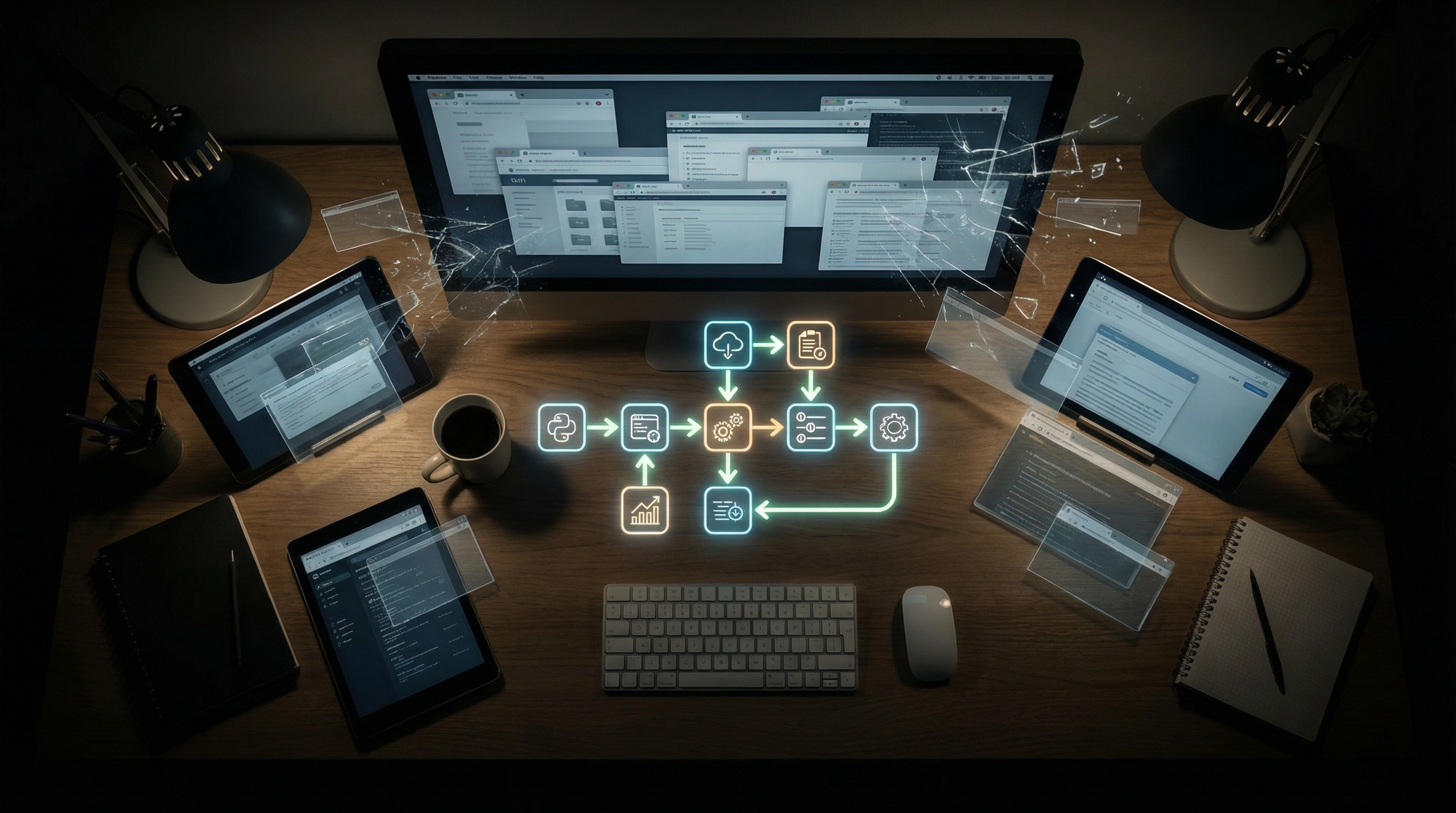
Software stocks entered a bear market in early 2026. The iShares Expanded Tech-Software ETF (IGV) dropped into bear market territory. Microsoft lost $360 billion in market cap in a single day. Salesforce fell 26% year-to-date. Over one trillion dollars in market value disappeared from software companies in the first week of February alone.
Forbes ran the headline. SaaStr called it a crash. Next Big Teng called it "The SaaSacre." Forrester called it "The SaaS-pocalypse." InvestorPlace went with "SaaSmageddon."
This is not a blip.
January 29, 2026 was the worst single day for software stocks since the Covid crash. On February 3, Palantir CEO Alex Karp said on an earnings call that AI is now "sophisticated enough to write and manage enterprise software, potentially rendering many SaaS companies obsolete." The next day, another trillion vanished.
Enterprise SaaS adoption peaked. Zylo's 2026 SaaS Management Index tracked a 0.07% year-over-year decline in app counts per company. The first time growth stopped. Fifty-three percent of organizations consolidated redundant SaaS in 2024, up from 40% the year before.
Something structural changed. AI agents are doing what the apps used to do.
The seat-based model is breaking
Every SaaS tool you pay for charges per seat. Salesforce charges per seat. Slack charges per seat. HubSpot charges per seat. The model assumes a human behind every seat, doing work that requires the software.
AI agents don't need seats.
Klarna replaced the work of 700 customer service agents with an AI system in 2024. The AI handled 2.3 million conversations in its first month, covering two-thirds of all customer service chats. Resolution time dropped from 11 minutes to under 2 minutes. The annual savings were projected at $40 million.
Klarna didn't cancel some seats on their customer service software. They cancelled the need for customer service software. They also eliminated 1,200 SaaS tools, including Salesforce and Workday.
This pattern is repeating across every category that involves repetitive work, processing data, generating reports, routing tickets, sending follow-ups, scheduling meetings, entering records. An AI agent connected to the right APIs performs these tasks without logging into a SaaS dashboard.
The SaaS application was a human interface layer. AI agents don't need a human interface layer.
The seat disappears. The subscription follows.

Which SaaS categories are most vulnerable
Not all software is equally threatened. The pattern is specific. SaaS tools that sit between data and action, where the human adds little judgment, are the first to go.
Customer support platforms. AI agents handle tier-1 tickets, route complex ones, and send acknowledgements. The helpdesk becomes a monitoring dashboard, not the primary work surface.
Email marketing tools. AI agents write, personalize, segment, and send. The Mailchimp UI becomes overhead for work the agent does faster without it.
Data entry and CRM hygiene. AI agents sync contacts between systems, clean duplicates, enrich records, and update pipeline stages. The human stops opening the CRM for these tasks entirely.
Scheduling and calendar management. AI agents negotiate meeting times, check availability, send invites. The scheduling tool becomes redundant.
Reporting and dashboards. AI agents query databases directly, generate summaries, and push them to Slack or email. The BI dashboard gets opened less each month.
The tools that survive are the ones where the human interface is the product. Design tools, collaborative documents, development environments. Software where humans are creating, not processing.
Automation platforms are the glue layer
When you cut five SaaS tools, the work still needs to get done. It doesn't disappear. It moves to a different layer.
Automation platforms like n8n, Zapier, and Make become the orchestration layer for your business. They connect the remaining tools, run the AI agents, and handle the data movement that used to require human logins across multiple dashboards.
We've tracked this pattern across hundreds of businesses. Your stack doesn't shrink to zero tools. It shrinks to three or four core tools plus an automation platform that handles everything else.
Your email marketing tool gets replaced by an AI workflow that uses the email API directly. Your helpdesk gets replaced by a workflow that reads inbound emails, classifies them, routes them, and responds to the simple ones. Your CRM stays, but the data entry work moves to an automated sync.
The automation platform becomes the most important piece of software in your stack. It replaces the tools you cancelled and it does the work that used to require those tools plus the humans who operated them.
The math for your business
The average small business spends $15,000 to $30,000 per year on SaaS subscriptions across 10 to 15 tools. We've seen this consistently in the data.
If AI-powered automation replaces 4 of those tools at an average subscription of $100 per month each, the savings are $4,800 per year.
The automation platform that replaces them costs $9 to $60 per month.
Annual cost | SaaS stack (before) | Automation stack (after) |
|---|---|---|
Core tools (3-4) | $6,000-12,000 | $6,000-12,000 |
Replaceable tools (4-6) | $4,800-7,200 | $0 |
Automation platform | $0 | $108-720 |
Total | $10,800-19,200 | $6,108-12,720 |
Savings | $4,692-6,480/yr |
The savings don't come from switching to cheaper SaaS alternatives. They come from eliminating entire categories of SaaS. The AI agent does the work. The automation platform runs the agent. The SaaS tool that charged per seat becomes unnecessary.

The window is open right now
SaaS consolidation creates a specific window. The businesses that restructure their software stack around automation platforms now will lock in savings before the automation platforms themselves raise prices.
n8n raised $180 million at a $2.5 billion valuation in October 2025. Zapier is already the most expensive option in the space. Make's pricing shifted to credits in August 2025 with AI operations costing more.
The platforms are getting more expensive over time, not less. But they're still dramatically cheaper than the SaaS tools they replace. An automation platform at $60 per month replacing four SaaS tools at $100 per month each saves $340 per month. Even if the automation platform doubles its price next year, you're still ahead.
The structure of the savings is what matters. You're replacing per-seat charges for 5 to 20 humans with a per-execution charge for an automated workflow. The economics are fundamentally different.
The SaaS crash is not a temporary correction. It is a structural shift in how businesses buy and use software. The seat goes away. The agent takes over. The automation platform becomes the operating system of the business.
We've seen the data from every angle. The stocks confirm it. The adoption numbers confirm it. The vendor cuts confirm it.
Your software stack is about to get smaller.
The question is whether you lead that change or let your competitors lead it first.
Market data from Bloomberg, Forbes, SaaStr (January-February 2026). SaaS adoption data from industry reports. Platform pricing verified March 2026.
Crux helps businesses find the right automation platform for their specific problem. We don't sell automation tools. We help you pick the right one.
Related Posts
What happens when your automation tool gets acquired
Every infrastructure tool you depend on will eventually be acquired, merged, or taken private. This isn't pessimism. It's pattern recognition. The history of enterprise software follows a rhythm a...
How Crux.do gives you answers AI tools cannot
Most workflow automation advice comes from two places: blog posts written by affiliate marketers who never built a workflow, or AI responses from ChatGPT, Claude, Perplexity, and Gemini trained on ...