Two protocols will decide how your AI agents talk to everything
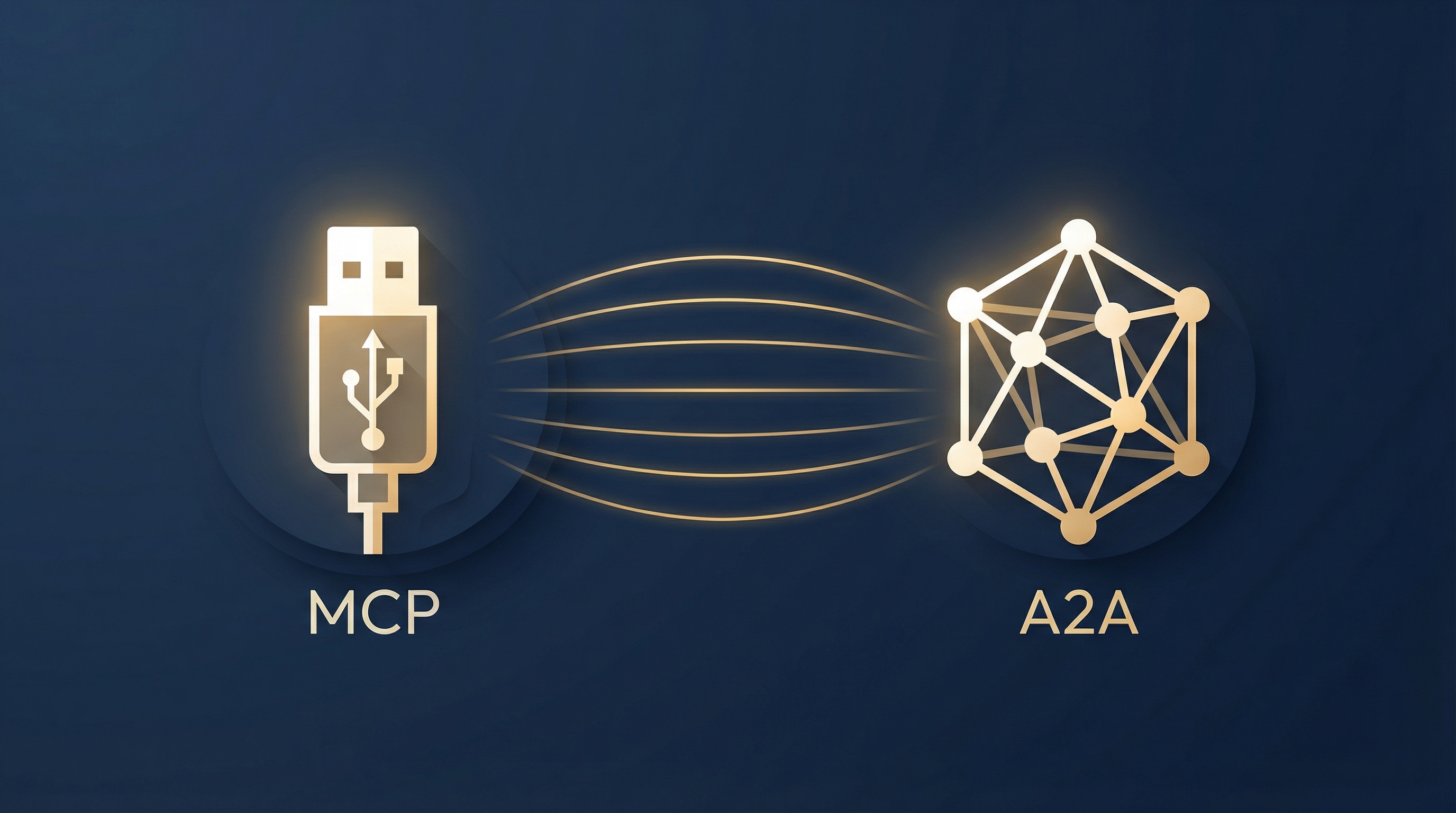
The automation stack is splitting into two layers. One layer connects AI agents to tools and data. The other connects AI agents to each other. Two protocols solving two different problems, both open source, both backed by trillion-dollar companies, and both now governed by the Linux Foundation.
We've tracked both protocols since launch. The pattern is clear: businesses that understand the distinction between MCP and A2A will build automation stacks that work across every platform, every vendor, and every AI model for years.
The businesses that don't will build on assumptions that break.
The protocols are MCP and A2A. One was built by Anthropic, the other by Google. They are not competing and they are not interchangeable. The businesses that treat them as alternatives will make the wrong architecture decision. The businesses that treat them as layers will get this right.
MCP is the USB-C port for AI
Model Context Protocol launched in November 2024. Anthropic built it and open-sourced it from day one.
The problem it solves is simple. Every AI model needs to connect to external tools, databases, and APIs. Before MCP, every connection was custom. If you wanted Claude to read your Google Drive, someone wrote a specific integration for Claude and Google Drive. If you wanted ChatGPT to do the same thing, someone wrote a different integration for ChatGPT and Google Drive.
This created an M times N problem. M models, N tools, M times N integrations. Every new model or tool added to the matrix.
MCP turns M times N into M plus N.
A tool publishes one MCP server. Every AI model that speaks MCP can use it. A model supports MCP once. Every MCP server becomes available.

The adoption curve was vertical. OpenAI adopted MCP across its Agents SDK and ChatGPT Desktop in March 2025. Google DeepMind followed in April. Microsoft brought it to Copilot and VS Code. AWS, Google Cloud, Azure, and Cloudflare all support it.
By March 2026, the numbers are staggering. Over 97 million monthly SDK downloads across Python and TypeScript. More than 10,000 active public MCP servers. First-class client support in ChatGPT, Claude, Cursor, Gemini, and Microsoft Copilot.
In December 2025, Anthropic donated MCP to the Agentic AI Foundation under the Linux Foundation, co-founded by Anthropic, Block, and OpenAI, with platinum members including AWS, Google, Microsoft, Bloomberg, and Cloudflare.
This is not an experiment. We've watched protocol wars for a decade, and this level of cross-vendor adoption in 12 months is infrastructure, not hype.
A2A is how agents talk to each other
MCP connects an agent to a tool. But what happens when you need two agents to work together?
Your sales agent finds a qualified lead. It needs to tell your onboarding agent to start the welcome sequence. That onboarding agent needs to tell your billing agent to create a subscription. Three agents, three frameworks, possibly three vendors.
Before A2A, this coordination was custom code every time.
Agent2Agent Protocol launched in April 2025 at Google Cloud Next. Google built it with 50 launch partners including Atlassian, Salesforce, SAP, PayPal, and ServiceNow. By February 2026, over 100 companies support the protocol.
A2A solves three problems at once.
Discovery. Every A2A agent publishes an Agent Card, a JSON file at .well-known/agent.json that describes what the agent can do. Other agents read the card and know what to ask for. No manual configuration.
Communication. Agents exchange tasks using HTTP and JSON-RPC. They can stream responses, handle long-running operations, and work across text, audio, and video.
Coordination. Agents manage task lifecycles, share context, and hand off work. The protocol defines how an agent signals completion and passes results to the next agent in the chain.
In June 2025, Google donated A2A to the Linux Foundation. IBM's Agent Communication Protocol merged into A2A in August 2025. The protocol now has governance from Google, Microsoft, AWS, Cisco, Salesforce, ServiceNow, and SAP.
DeepLearning.AI launched a course on A2A in January 2026. Google Cloud and IBM Research built it together. The curriculum walks through building a multi-agent healthcare system with three specialized agents using different frameworks.
The standard is real. The ecosystem is forming.
They solve different problems
We've found the simplest way to explain the difference.
MCP is the USB-C port, connecting a device to peripherals. A2A is TCP/IP, connecting devices to each other. Both are necessary and they don't overlap. Every automation stack will eventually speak both protocols.
MCP | A2A | |
|---|---|---|
Direction | Vertical: agent to tools | Horizontal: agent to agent |
Purpose | Access data, run actions | Discover, coordinate, hand off |
Built by | Anthropic (Nov 2024) | Google (Apr 2025) |
Governed by | Agentic AI Foundation | Linux Foundation |
Adoption | 10,000+ servers, 97M+ downloads | 100+ companies |
Google explicitly states that A2A and MCP "are not competing but complementary." Real-world systems use both. MCP for tool integration. A2A for agent orchestration.
The confusion comes from people treating them as alternatives. They are layers.
What the platforms support today
We checked every major automation platform for protocol support. All four have adopted MCP. None have adopted A2A yet.
This makes sense. Automation platforms are tools, not agents, and MCP is the protocol for tools.
Platform | MCP Support | A2A Support |
|---|---|---|
n8n | MCP Client node and MCP Server Trigger. Can consume and expose MCP servers. | Not yet |
Zapier | MCP server connecting 8,000+ apps and 30,000+ actions. MCP Client in beta since January 2026. | Not yet |
Make | MCP Server and MCP Client. Scenarios become AI-callable tools. | Not yet |
Activepieces | 400+ open-source Pieces available as MCP servers. 60%+ community-contributed. | Not yet |

The practical takeaway for most businesses: MCP support is what matters for choosing your automation platform today. All four major platforms have it. You are not locked in.
A2A matters when you're building multi-agent systems across vendors. That is an enterprise concern right now, not an SMB one. Give it 12 to 18 months.
Gartner predicts that by end of 2026, 75% of API gateway vendors and 50% of iPaaS vendors will have MCP features. It is becoming table stakes.
The security question nobody is asking
There is a cost to open protocols with rapid adoption. Supply chain attacks.
In September 2025, security researchers discovered the first real-world malicious MCP server. An npm package called "postmark-mcp" silently BCC'd every email sent through it to an attacker's address. It accumulated 1,643 downloads before removal.
Qualys flagged MCP servers as "the new Shadow IT for AI" in March 2026. The concern is real. When you connect an MCP server to your automation platform, you're giving it access to your business data and the ability to take actions on your behalf.
The same supply chain risks that plague npm and PyPI now apply to your automation infrastructure.
Before connecting any MCP server to your business tools, verify the publisher, audit the source code if it's open source, and start with read-only permissions before granting write access.
What this means for your business
We track protocol adoption across every major automation platform. The pattern is clear.
MCP won. Not because it was first, but because it solved the most immediate problem, connecting AI to existing tools, and every major vendor adopted it within 12 months.
A2A is winning the agent-to-agent layer. The governance structure is stronger, the backing is broader, and no serious competitor has emerged.
Two protocols, two layers, both open source, both governed by foundations that include every major cloud provider.
For businesses choosing an automation platform in 2026, the protocol question has a simple answer: pick any platform that supports MCP, because all four major ones do and the coverage is already there.
For businesses building multi-agent systems, watch A2A closely. The course materials exist, the SDKs exist, and the enterprise partners are building production implementations. But most businesses don't need A2A yet unless they're coordinating agents across multiple vendors and frameworks.
The standards war ended before most businesses knew it started. MCP handles tools and A2A handles agents, both under the Linux Foundation, both backed by the companies that define the market.
The question isn't which protocol to choose. It's whether you're building on protocols at all, or still running custom integrations that break every time a vendor ships an update.
We've watched every platform war in automation since the beginning. The ones that adopt open standards early survive. The ones that don't become migration stories.
Your automation stack should speak both protocols. The platforms that support them already do.
Pricing and platform data verified March 2026. Protocol adoption data from official announcements and Gartner reports.
Crux helps businesses find the right automation platform for their specific problem. We don't sell automation tools. We help you pick the right one.
Related Posts
Zapier AI agents and MCP explained for non-technical teams
Automation just crossed a line. For fifteen years, every workflow tool on the market asked the same question: what should happen when this trigger fires. The builder defined the rules. Mapped every...
The first malicious MCP server was caught stealing every email you sent
The protocol that connects AI tools to business data has its first supply chain attack. It will not be the last. An npm package called "postmark-mcp" looked like a legitimate tool, claiming to con...